


Why the symptom returns: clinical reasoning in musculoskeletal pain diagnosis
Mauro Lastrico, Laura Manni – Physiotherapists
When a musculoskeletal symptom returns after treatment, the cause lies outside the treated segment. In the presence of a mechanical symptom, four recurrent constants are observed: intra-articular mechanical conflict, asymmetric vector shortening, systemic misalignment, and systemic distribution of shortening. The distinction between primary and secondary shortening determines therapeutic strategy and prognosis.
The attached PDF document, available for free download, develops the complete model with images and bibliographic references.
The four constants (4K)
When a symptom caused by mechanical conflict appears, in the absence of congenital or acquired disorders, four recurrent constants are observable.
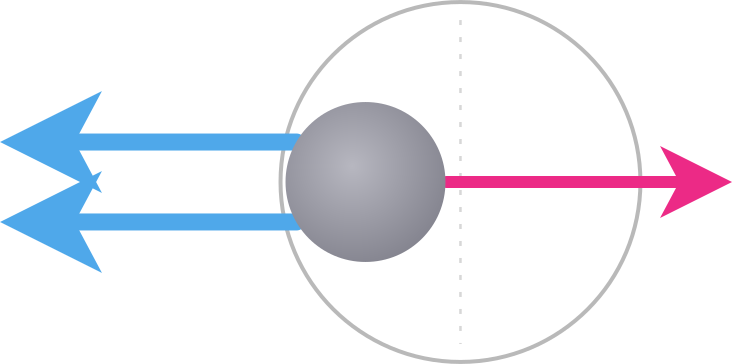
First constant: the symptom or functional impairment is determined by intra-articular mechanical conflict. G and R forces concentrate in restricted areas instead of being distributed uniformly across the articular surfaces.
Second constant: the muscular vectors that should ensure correct articular alignment are asymmetrically shortened along dominant vector lines. No joint "moves out of place by itself." It is the asymmetry of muscular traction forces that determines alteration of the physiological articular sequence.
Third constant: in the presence of a symptom, not only the symptomatic joint but all joints in the body are involved in misalignment to a greater or lesser extent. Often the most misaligned joints are not the symptomatic ones. The symptomatic joint may represent the "breaking point" of a system already compromised as a whole.
Fourth constant: muscular shortening is distributed throughout the entire system, not only locally.
In the absence of symptoms, the third and fourth constants are still present. Symptom onset is linked to the time factor and the accumulation of shortening — it represents the exhaustion of the protective mechanisms of the a priori antalgic reflexes.
Differential diagnosis: local or referred symptom
A local symptom may be sustained by three conditions: articular mechanical conflict with alteration of the articular sequence, alteration of muscular dynamics with substitutive mechanisms producing aphysiological motor patterns even in the absence of obvious static alteration, or intrinsic muscular problems — localised contractures, trigger points, alterations of the contractile and connective components — that have not yet produced significant changes in the articular axis.
A referred symptom may be sustained by three origins: axial alterations in other body districts propagating along functional connections, peripheral symptoms of vertebral origin following dermatomal projections of the corresponding nerve roots, or secondary muscular shortening triggered by problems arising from other body systems.
Viscero-somatic correlations
Visceral pathologies or dysfunctions may determine somatic symptoms through neurological organ-vertebra connections. Symptoms may manifest both at the vertebral level and peripherally, following neural projections. Principal correlations: skull–C2 with ENT and TMJ; C3–T2/T3 with oesophagus, diaphragm, heart; T4–T5 with stomach and lungs; T6–T9 with duodenum, liver, intestine, pancreas, biliary tract, spleen; T10–L2 with diaphragm, adrenals, kidneys, ureters; L3–coccyx with colon, bladder, genital organs.
The differential diagnostic criterion between a primarily vertebral problem and one secondary to visceral dysfunction is treatment response: if the problem is vertebral, vector rebalancing is decisive and stable; if of visceral origin, improvements are temporary and the symptom tends to recur.
Primary and secondary shortening
Primary shortening is determined by the action of the three systems — psychosomatic, neurophysiological, and biomechanical — and represents the largest group of causes underlying musculoskeletal symptoms. Vector rebalancing may be decisive.
Secondary shortening is the adaptive consequence of structural or functional alterations in other systems: stomatognathic, skeletal, visceral, visual, auditory, neurological. Without resolution of the primary cause, work on the muscular system cannot remain stable over time.
The most relevant clinical signal is therapeutic instability: articular corrections are lost and symptoms recur. This indicates that the primary cause is still active.
The two equations
First equation — primary shortening: absence of alterations in other systems → primary muscular shortening → alteration of the articular sequence → mechanical conflict = pathology. Solution: vector rebalancing.
Second equation — secondary shortening: alteration in other systems → secondary muscular shortening → alteration of the articular sequence → mechanical conflict = pathology. Solution: intervention on the primary cause.
Behind different diagnostic labels — epicondylitis, carpal tunnel syndrome, low back pain, neck pain — are local manifestations of one of these two processes. The distinction between them concretely determines therapeutic approach and prognosis.
Physical foundations of the model.
This article applies the AIFIMM biomechanical model.
Its physical foundations are developed in three sequential articles, best read in order:
1. How muscle shortening generates joint conflict — why muscles shorten and the Resistant Force / Working Force model
2. Do antigravity muscles really oppose gravity? — how segmental malalignment raises Resistant Force
3. Why joint conflict develops: vector analysis of muscular forces — how the responsible forces are identified and predicted
This topic is part of the online course MSK Clinical Vectorial Model.