


Do antigravity muscles really oppose gravity?
Mauro Lastrico, Laura Manni – Physiotherapists
So-called antigravity muscles do not oppose gravity. The weight force is constantly balanced by the ground counterforce. The task of the muscular system is to align segmental centres of mass along the vertical of the counterforce, distributing loads evenly across joints and the spinal column. When muscular organisation is altered, centres of mass become misaligned: joint compressions increase and the tone required to maintain equilibrium rises.
The attached PDF document, available for free download, develops the complete physical model with images and bibliographic references.
Gravity and counterforce
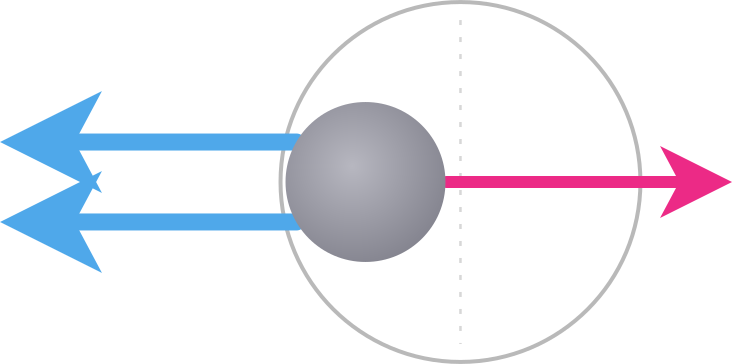
Gravity is an interaction between masses. The human body in standing is subjected to two forces: the weight force G, directed downward, and the ground counterforce R, equal and opposite. The muscular system does not need to "overcome" gravity — it needs to manage how the weight force is distributed through bodily structures.
The common representation of gravity as a force that "crushes" the body downward is misleading. Gravity acts constantly and uniformly. What varies is how its components are distributed through the structures. Load concentration depends on the alignment of body segments, not on gravity itself.
Conditions of equilibrium
A body is in stable equilibrium when G and R lie on the same vertical, at the centre of the support polygon. In this condition, the g and r components are distributed uniformly across the support surfaces.
When G and R remain on the same vertical but at the limits of the support polygon, equilibrium is still possible, but forces converge at a point rather than being distributed. When the two forces are no longer aligned on the same vertical, a moment of force M is generated, rendering equilibrium unstable.
The multi-segment system: the stacked boxes analogy
When multiple boxes are stacked, each one interacts with the one below it. Overall equilibrium depends on alignment. If the boxes are not aligned on the same vertical, the g and r forces concentrate at specific points rather than being distributed, creating structural compressive phenomena.
The human body works the same way. Each body segment has its own centre of mass. If segmental centres of mass are misaligned, the g and r components concentrate on restricted joint surfaces. The task of the muscular system is to maintain G and R aligned on the same vertical through optimal alignment of segmental centres of mass.
Equilibrium and muscle shortening
Shortened muscles alter the position of segmental centres of mass. The neuromuscular system implements compensatory strategies through tone modulation to maintain the global centre of mass G along the vertical of counterforce R.
This generates a chain of adaptations. If the hamstrings are shortened, the pelvic centre of mass shifts posteriorly relative to the vertical passing through the medial plantar arch. To maintain G–R equilibrium, the system automatically modulates tone in other muscle groups, creating a cascade of adaptations involving the entire musculoskeletal system.
Load concentrations on restricted joint surfaces are the mechanical effect of the system's attempt to maintain equilibrium in the presence of muscle shortening. They are a consequence, not a cause.
Equilibrium and Resistant Force
When segmental centres of mass are misaligned, certain muscle groups must chronically increase tone to maintain equilibrium. This chronic increase raises Resistant Force at the expense of Work capacity. Muscle fatigue does not arise from gravity itself but from energetic inefficiency caused by maintaining non-optimal alignment.
A system with correctly aligned centres of mass requires minimal muscular effort to maintain position.
The physical foundations of the model
This article is the second of three sequential foundations of the AIFIMM model:
How muscle shortening generates joint conflict — why muscles shorten and the Resistant Force / Working Force model
Why joint conflict develops: vector analysis of muscular forces — how the responsible forces are identified and predicte
This topic is part of the online course MSK Clinical Vectorial Model.