


Applied physics for musculoskeletal clinical practice
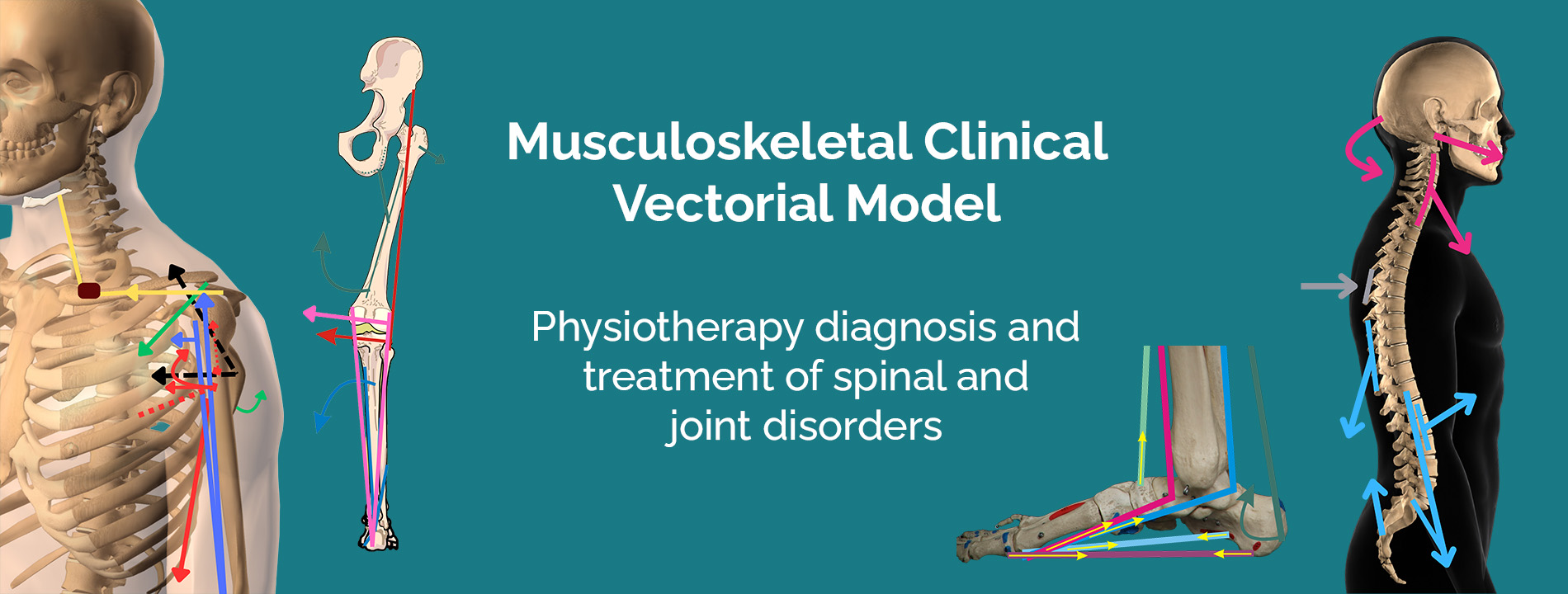
Muscles generate forces. Those forces determine joint positioning. When muscles shorten structurally, the resulting force configurations alter joint axes, load distribution, and movement efficiency.
Vector analysis allows you to identify these forces, predict their mechanical effects, and guide intervention from assessment to treatment.
This is the foundation of everything we teach: a physics-based clinical reasoning model that connects biomechanical assessment directly to therapeutic decision-making in joint and spinal pathologies.
The AIFIMM biomechanical model is formalized in a peer-reviewed paper by Mauro Lastrico, co-founder and instructor at AIFIMM, published by Elsevier and indexed in the major international scientific databases.
The same author has documented its clinical foundations in a series of articles on the CPD Certification Service (UK).
From assessment to prediction to intervention
The model identifies the muscular vectors responsible for joint and vertebral misalignments, analyzes their interactions, and anticipates how they will evolve.
Treatment integrates systemic rebalancing with selective intervention on the muscles directly responsible for the clinical picture.
Segmental and systemic analysis proceed in parallel — reducing distant compensations, increasing the stability of clinical results, and accelerating symptomatic response.
Independent certification
Course content independently evaluated by the CPD Certification Service (UK) and approved by CE Broker (USA, Florida). Credits recognized in international continuing education systems.
Online course
38 hours of on-demand video with live clinical demonstrations, downloadable PDF materials, and direct chat with instructors throughout the course. Biomechanical principles introduced progressively, from clinical observation to the underlying physical laws.
Scientific publications
Peer-reviewed articles and books grounded in applied physics, connective tissue mechanics, and vector-based musculoskeletal analysis.
Assessment and treatment
Hypothesis verification
Predictive capacity
Differential reasoning
Featured articles
Mauro Lastrico, Laura Manni – Physiotherapists
Mauro Lastrico, Laura Manni – Physiotherapists
Mauro Lastrico, Physiotherapist and AIFIMM instructor. Published by Elsevier, peer-reviewed, and indexed in Scopus, Web of Science, and EMBASE.