


How muscle shortening generates joint conflict: the role of connective tissue
Mauro Lastrico, Laura Manni – Physiotherapists
Muscle shortening is a physical phenomenon governed by the elastic properties of connective tissue. Understanding the mechanism that produces it allows the identification of the mechanical cause of joint conflicts, spinal compressions, and alterations of physiological joint sequencing.
The attached PDF document, available for free download, develops the complete physical-mathematical model with images and bibliographic references.
Two elastic materials, two different behaviours
Muscle contains two materials with different elastic properties. The contractile component — actin and myosin — has a high elastic modulus: it contracts, relaxes, and tends to return to its initial condition. The connective component — membranes, endomysium, perimysium, tendons — has a low elastic modulus: subjected to force for a sufficient time, it deforms and the deformation becomes residual.
Persistent muscle shortening develops in the connective components arranged in parallel, subjected to compression during every contraction. The force × time product determines the magnitude of the residual deformation.
What shortening produces at joint level
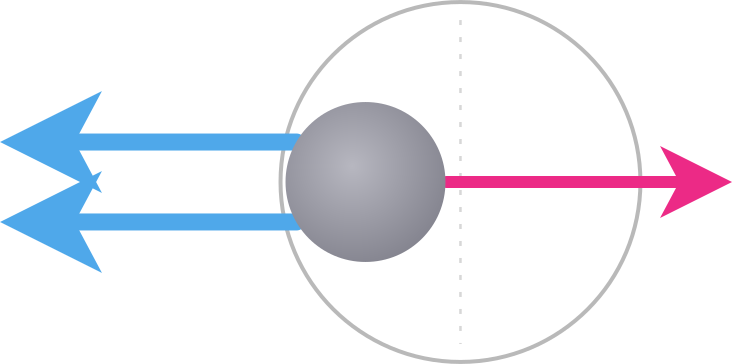
Muscle is a compressive force. When it shortens, it pulls on the bony attachments where it inserts. The result is a modification of joint axes: articular surfaces are no longer aligned according to physiological geometry. Force lines concentrate in restricted areas of the joint surface, generating asymmetric overload and persistent intra-articular compression.
This mechanism explains why osteoarthritis is an effect rather than a cause. Cartilage degeneration is the consequence of abnormal force distribution, not the starting point.
Internal load and external load
In clinical language, the term "load" is often associated with body weight or external resistance. The musculoskeletal system can be subjected to high mechanical loads even in the absence of relevant external forces, when internal forces generated by shortened muscles produce persistent joint compression. The load that generates joint conflict is internal, not external.
Resistant Force, Work, and Power
Connective shortening increases Resistant Force — the resistance the muscle opposes to lengthening. Simultaneously it reduces the capacity for Work and Power. The muscle retains its contractile capacity but must spend part of its energy overcoming its own internal resistance before producing useful movement. The muscle is not weak: it is mechanically inefficient.
The clinical example is an elbow locked in flexion after cast removal. The flexors are shortened, they resist extension both passively and actively, but their dynamic capacity is reduced because available energy is dissipated against internal connective resistance.
Systemic implications
Shortening does not remain isolated. Altered muscle length forces joints to adapt along new axes. The system adopts alternative movement patterns to maintain function. These patterns generate further compensatory shortening in other muscle districts. The nervous system, through body schema plasticity, normalises these alterations as a new baseline condition. A self-reinforcing loop is established.
Reversibility
The same physical laws that explain shortening define the principles of its reversibility. Connective tissue, having an elastic modulus lower than 1, retains the capacity to deform in both shortening and lengthening. Reversibility requires the application of appropriate forces for durations compatible with the viscoelastic properties of the biological material.
Continue with the physical foundations of the model
Do antigravity muscles really oppose gravity? — how segmental malalignment raises Resistant Force
Why joint conflict develops: vector analysis of muscular forces — how the responsible forces are identified and predicted
This topic is part of the online course MSK Clinical Vectorial Model.