
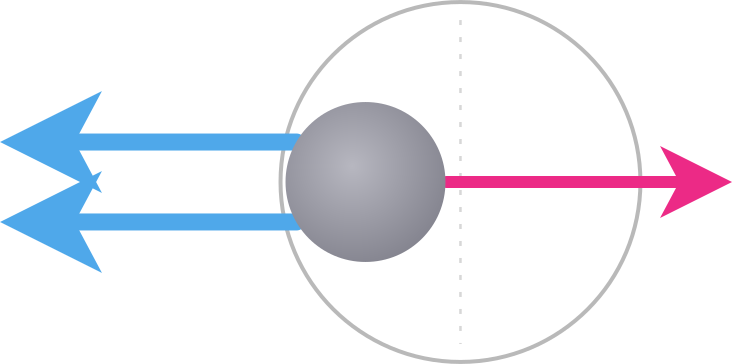


Why joint conflict develops: vector analysis of muscular forces
Mauro Lastrico, Laura Manni – Physiotherapists
Every joint malalignment, in the absence of specific pathology, is the result of unbalanced muscular forces. Vector analysis identifies which muscles are responsible for the alteration of physiological joint sequencing and predicts the compensatory patterns the system develops in response.
The attached PDF document, available for free download, develops the complete vector analysis with images and bibliographic references.
Muscle as a force vector
Muscle exerts exclusively tensile forces, pulling its insertions closer together. No muscle pushes. Joint rotations do not arise from lever systems but from the application of tensile forces whose line of action does not pass through the joint axis. Certain anatomical structures — malleoli, patella — act as pulleys redirecting the direction of traction, not as levers.
Each muscle can be represented as a vector with three elements: magnitude, direction, and sense. The parallelogram rule allows calculation of the resultant of multiple muscular forces and, conversely, identification of which muscles are responsible for an observed deformity.
Anatomical vector dominances
In nearly all joints, muscular forces are vectorially asymmetric. Dominant and subdominant actions are distinguished. In the scapulohumeral joint, for example, the humeral internal rotators are dominant over the external rotators: they are greater in number, with longer and more oblique vectors. If the internal rotators express at high intensity, the vector resultant of the external rotators cannot balance them.
These anatomical dominances become particularly evident in neurological conditions such as spastic hemiparesis, where loss of supraspinal inhibitory control allows intrinsic dominances to manifest fully. It is rare to observe a hemiparetic patient with the humerus in spontaneous external rotation.
Although the neurophysiological mechanisms of spasticity differ from physiological muscle shortening, both conditions reveal the same anatomical reality: intrinsic vector asymmetries exist that, when unbalanced, determine predictable patterns of joint alteration.
The concept of "muscle weakness" revisited
In vector logic, in the absence of peripheral neurological pathology, subdominant actions are not impeded by weakness of the agonists but by excess tension of the antagonists. The humeral external rotators are not in hypocontractile capacity: it is the internal rotators in excess tension that impede the action.
In statics, what is perceived as "weakness" in maintaining position is the effect of excess tension of the dominant antagonists. In dynamics, shortening of both agonists and antagonists requires that both overcome their own internal Resistant Force before producing useful movement. The result is less fluid movements, limited in range, or requiring compensatory strategies to be completed.
Rebalancing is not achieved by strengthening muscles in a lengthened position but by reducing excess tension of the dominant muscles.
Vector obliquity and force effectiveness
A determining parameter is the obliquity of force application. An oblique force requires greater intensity to be balanced. When an oblique force and a longitudinal force parallel to the segment act on a skeletal segment, the latter cannot balance the oblique force except by stiffening the segment in compression.
This principle explains why muscles with oblique vectors — such as the latissimus dorsi or hip rotators — have a greater deforming potential than longitudinal muscles.
Residual shortening: minimal percentages, significant effects
Residual shortening of connective tissue components persists even after muscle relaxation. Shortening percentages of 1–2% are sufficient to limit joint range by 10–15 degrees.
The clinical example: after cast removal, the typical 10–15° limitation in full elbow extension corresponds to a residual shortening of the flexors of only 4–6 millimetres over a muscle length of 30 centimetres — approximately 1.5–2%. The triceps has not become "weak": the flexors have developed this minimal residual shortening of connective tissue components, sufficient however to prevent the last degrees of extension due to the increase in Resistant Force.
Linear and non-linear mathematics
Vector analysis uses linear mathematics for analytical study of individual regions: a proportional relationship between stimulus and effect, allowing prediction of the action of a muscular force on a specific skeletal structure.
Non-linear mathematics applies to systemic analysis: small signals can produce large variations. This explains why apparently negligible muscle shortenings can generate significant clinical presentations and widespread symptoms. When analysis of the most probable vectors proves negative, the same procedure is applied to minor vectors — where the rules of non-linear mathematics explain how even small signals can produce significant changes.
The physical foundations of the model
This article is the third of three sequential foundations of the AIFIMM model. The two that precede it:
How muscle shortening generates joint conflict — why muscles shorten and the Resistant Force / Working Force model
Do antigravity muscles really oppose gravity? — how segmental malalignment raises Resistant Force
This topic is part of the online course MSK Clinical Vectorial Model.