


Why muscle strengthening alone does not correct joint alignment
Mauro Lastrico, Laura Manni – Physiotherapists
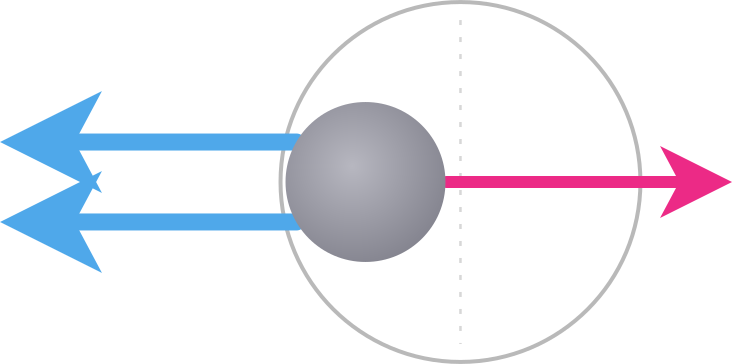
Strengthening a subdominant muscle cannot modify joint alignment as long as the dominant vector opposes a Resistant Force greater than the Work Force the subdominant muscle can express. Strengthening a muscle in a vectorially unbalanced system consolidates the compensatory pattern instead of correcting it. Reducing Resistant Force in shortened muscles is the biomechanical prerequisite for strengthening to become effective.
The attached PDF document, available for free download, develops the principles of clinical application with images and bibliographic references.
The limit of spontaneous movement
No spontaneous human movement is capable of re-lengthening a shortened muscular system. Spontaneous movements always respect the limits imposed by existing shortenings: the body cannot voluntarily overcome its own structural restrictions. Recovery of length requires specific guided therapeutic exercises that bring the tissue beyond the limits the nervous system has accepted as normal.
Two portions of the muscle fibre, two different approaches
The contractile portion — in which basal tone essentially increases — is simpler to treat because it responds to any muscle relaxation technique. The limitation of these techniques is that they are ineffective on the connective tissue portions.
The connective tissue portion — in which true residual shortenings accumulate — requires therapist intervention, through deep massage along the fibre direction or, more effectively, through isometric contractions performed at the point of maximum physiological or relative lengthening of the muscle fibre.
Isometric contraction produces lengthening of the connective tissue portion only if performed at the point of maximum fibre lengthening. If performed below the maximum available lengthening, the effect will be further shortening of the connective tissue component.
During isometric contraction at maximum lengthening, the contractile portions actively shorten and exert traction on the connective tissue portions. Since the elastic modulus of the contractile portions is higher than that of the connective tissue portions, the residual shortening of the contractile portions will be less than the residual lengthening of the connective tissue portions. After treatment, any relaxation technique suffices to resolve the residual shortening of the contractile portions.
The roof metaphor: local and systemic logic
Systemic muscular shortening can be compared to lowering the roof of a house. To continue standing upright, each person develops adaptive strategies: bending the knees, inclining the trunk, inclining the head. These strategies are useful short-term but maintain and reinforce the problem.
Treatment is effective only if, by the end of the session, the roof has been raised. But a purely systemic approach risks being too generic and failing to resolve specific problems. If a shoulder presents a local mechanical conflict, a specific intervention is necessary to vectorially rebalance that region — but the local intervention must occur without producing systemic aggravation. If the roof does not rise, or even lowers further, the system will tend to return to the previous dysfunctional equilibrium.
Why strengthening before rebalancing does not work
Strengthening applied before vector rebalancing presents three critical issues. It does not modify the Resistant Force of the muscles responsible for joint displacement — any increase in Work Force by the target muscles is dissipated in the attempt to oppose dominant forces that have not been reduced. It increases the overall resistance of the system — in a complex system all elements are interdependent, so strengthening also increases the Resistant Force of the dominant muscles, worsening compressive forces on the joint. It strengthens the compensatory pattern — the neuromuscular system, unable to correct alignment, develops alternative strategies that, once strengthened, become more stable and harder to modify.
The therapeutic sequence: first rebalancing, then strengthening
The preparatory phase focuses on reducing Resistant Force in shortened muscles, rebalancing dominant vectors, restoring physiological joint alignment, and reducing joint conflicts and compensations.
Once coherent joint mechanics have been restored, strengthening becomes fully applicable: it consolidates the correction obtained, increases the Work Force of previously subdominant muscles, improves functional capacity and system resilience, and prevents recurrence.
Strengthening is neither excluded nor considered harmful. It belongs to the subsequent phase, when biomechanics have been sufficiently restored. Lengthening treatment reduces Resistant Force; strengthening, applied at the appropriate time, increases Work Force and consolidates functional stability. They are complementary interventions, not alternatives.
The existing equilibrium is not an error
The equilibrium present in each person, however apparently pathological, represents the best solution the system has found to avoid worse conflicts. An elevated shoulder, a vertebral rotation, a pelvic inclination are not simply "errors" to be mechanically corrected, but adaptive strategies organised by the subcortical system. Correcting a visible asymmetry without understanding the systemic logic that generated it may produce conflicts more serious than those immediately apparent.
Physical foundations of the model.
This article applies the AIFIMM biomechanical model.
Its physical foundations are developed in three sequential articles, best read in order:
1. How muscle shortening generates joint conflict — why muscles shorten and the Resistant Force / Working Force model
2. Do antigravity muscles really oppose gravity? — how segmental malalignment raises Resistant Force
3. Why joint conflict develops: vector analysis of muscular forces — how the responsible forces are identified and predicted
This topic is part of the online course MSK Clinical Vectorial Model.