


Cranio-cervico-mandibular disorders: when jaw pain comes from the neck and vice versa
Mauro Lastrico, Laura Manni – Physiotherapists
Temporomandibular joint dysfunction is rarely a primary cause. In the majority of cases, it is the final manifestation of alterations originating in other body districts. Biomechanical analysis identifies three pathways through which cranio-cervico-mandibular disorders develop and provides criteria for distinguishing whether the problem is dental, sensory, or muscular — a distinction that determines the therapeutic strategy.
The attached PDF document, available for free download, develops the complete analysis with images and bibliographic references.
Three pathways, three different origins
The first pathway originates from an alteration in the mandibulo-cranial skeletal relationship. A structural problem at the dental level activates muscular compensations producing mandibular deviation, articular compression, and TMJ symptoms. Muscular shortening is secondary.
The second pathway originates from disorders of sensory input — visual or auditory. Altered sensory information determines cranio-cervico-scapular muscular compensations that modify the position of the vertebrae and hyoid bone, secondarily involving the TMJ muscles. Shortening is again secondary.
The third pathway originates directly in the muscular system. Cranio-cervico-scapular shortening, without identifiable structural or sensory causes, alters the position of the vertebrae and hyoid bone, with secondary TMJ involvement. Shortening is primary.
The distinction between primary and secondary shortening determines the therapeutic strategy. If the cause is dental, muscular treatment alone will not stabilise results. If the cause is primary muscular, work on the muscles can produce resolution of the symptomatology.
Three occlusal problems with systemic consequences
Difference in tooth height: when a dental arch contains teeth that are too short or too long, the masticatory muscles act asymmetrically and with greater intensity than physiologically necessary. The mandibular condyle on the side of the "short" teeth rises toward the temporal fossa. The mandible performs a torsional movement. Asymmetrical muscular activation determines involvement of other districts through the hyoid muscles.
Excessive freeway space: with teeth that are overall too short, the muscles anterior to the cervical spine, taking T3 as a fixed point, shift the entire head forward with synergic help from the scalenes. The dental arches move closer together, unloading the work of the masticatory muscles. But anterior head displacement modifies the body's centre of mass and activates compensations throughout the entire vertebral sinusoid.
Reduced or absent freeway space: the muscles posterior to the cervical spine activate to extend the cranium posteriorly, allowing mouth opening and unloading the work of the hyoid muscles.
The mandibular locking mechanism
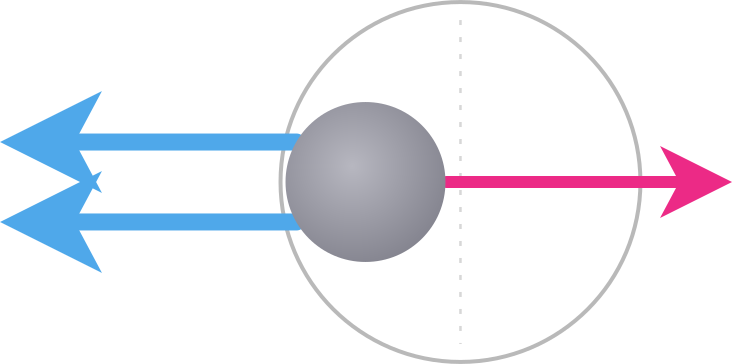
The closing muscles — masseters, temporalis, medial pterygoids — are vectorially dominant over the hyoids. If the closing muscles are shortened, mouth opening becomes limited or impossible.
Since mouth opening is a priority function, a compensatory strategy intervenes: the lateral pterygoids, instead of limiting themselves to a control function, take the cranial insertions as the fixed point and pull the condyles forward, producing a "jerking" mandibular opening. Opening occurs in subluxation, in the direction of the temporal crest. Subluxation is therefore a consequence, not the cause, of the problem.
Diagnostic tests
The closing test evaluates upward displacement of the condyle into the temporal fossa — always determined by a dental problem. The operator places the little fingers in the patient's auditory canals and perceives skeletal contact during closing.
The opening test identifies compensatory intervention of the lateral pterygoids. The operator perceives an acceleration of mandibular movement signalling substitution of the hyoids by the lateral pterygoids. The earlier the acceleration occurs, the more severe the problem induced by shortening of the closing muscles.
The bite test distinguishes three conditions. Negative bite: no evident variation in skeletal relationships — the teeth do not interfere with the myofascial system. Positive bite with correction: evident improvement in skeletal relationships — the teeth interfere and referral to the specialist is appropriate. Positive bite with worsening: tooth position is not the primary problem and gnathological intervention at that moment would create an additional disturbing factor.
Physical foundations of the model.
This article applies the AIFIMM biomechanical model.
Its physical foundations are developed in three sequential articles, best read in order:
1. How muscle shortening generates joint conflict — why muscles shorten and the Resistant Force / Working Force model
2. Do antigravity muscles really oppose gravity? — how segmental malalignment raises Resistant Force
3. Why joint conflict develops: vector analysis of muscular forces — how the responsible forces are identified and predicted
This topic is part of the online course MSK Clinical Vectorial Model.