


Pain neuroscience and muscle shortening: three systems, one final effector
Mauro Lastrico, Laura Manni – Physiotherapists
Muscle shortening is not a random phenomenon. It is the result of precise physiological mechanisms leading to increased basal tone. When this increase persists over time, it progressively involves the connective tissue component of the muscle fibre, producing the permanent residual shortening observed in segmental analysis. Three different systems use the muscle as their final effector: the psychosomatic system, the neurophysiological system, and the biomechanical system. Each may act independently or in synergy with the others. This distinction guides therapeutic strategies.
The attached PDF document, available for free download, develops the complete model with images and bibliographic references.
The psychosomatic model: character armour and muscular armour
The earliest formulations on the relationship between character structure and muscular structure date back to the 1920s with Wilhelm Reich and later Alexander Lowen. According to this view, tensions accumulated in the body and attitudes aimed at blocking emotions give rise to a dual armour: character armour and muscular armour.
The formation of bodily armour occurs through elevation of basal tone — excess tension in the contractile portion of the muscle fibre. If this condition persists, the connective portion is involved, producing actual shortening that in turn alters the physiological articular sequence. A myotensive state of emotional origin may therefore evolve and become associated with a biomechanical problem.
The neurophysiological model: protective reflexes and antalgic reflexes
Muscle tone is the resultant of psycho-neurophysiological processes within the tonic postural system. Cortical centres process motor goals — the "what" of action — while subcortical centres regulate execution — the "how" — through automated neural patterns. The less accurately the body schema is neurally represented, the more the muscular system is activated with excess tension through unnecessary co-contractions and substitutive patterns.
Subcortical centres activate two types of protective mechanisms:
Physiological mechanisms are muscular contractions maintained after an orthopaedic traumatic event. Example: in an ankle sprain, subcortical centres send a contraction signal to all periarticular muscles to immobilise the joint. Contraction continues until injured structures are repaired. Duration is proportional to damage, and so is residual shortening.
Functional mechanisms are the core of the model. They are distinguished as:
A posteriori antalgic reflex: contraction maintained to reduce or eliminate existing pain. People in acute pain adopt contorted bodily configurations but report that "it feels a little better like this." This strategy is useful in the immediate situation but, if persistent, becomes the cause of further mechanical conflicts.
A priori antalgic reflex: permanently active contraction whose purpose is to prevent latent mechanical conflicts from manifesting. Progressive muscular shortening, as long as it does not itself create conflict, prevents the de-latentisation of musculoskeletal discomfort. Subcortical centres use the muscular system by distributing shortenings to alter all articular sequences systemically in order, as long as possible, to avoid local conflicts.
The a priori antalgic reflex also manifests through adoption of specific bodily configurations and non-random motor choices. Initially these constraints are unconscious — one "feels" the need to move in a certain way. If shortening becomes more pronounced, constraints become conscious: "I can't sit for long otherwise...", "I can't walk slowly otherwise...".
The biomechanical model: from the edge of chaos to rigidity
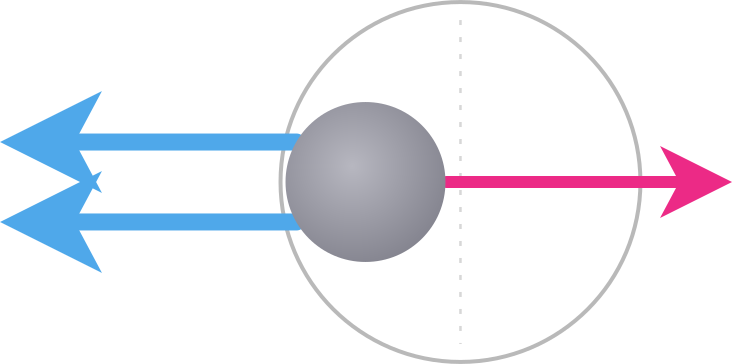
When muscular forces are balanced at low intensity, the system is at the edge of chaos: stability and articular mobility coexist, and small amounts of energy suffice to pass from one state to another. If balancing occurs at high intensity, skeletal axiality remains possible but movement requires more energy, static elements prevail over dynamic ones, and the system becomes rigid.
If elevated basal tone persists, dominant muscles produce vector imbalance. The system adapts at the price of segmental skeletal misalignments. Centres of mass are no longer aligned, G and R forces concentrate on restricted areas of joint surfaces, and a self-reinforcing circuit is triggered: misaligned centres of mass → increased basal tone → connective shortening → further misalignment.
Integration of the three systems
The three systems are interdependent: whatever system is primarily implicated in the imbalance, the others must implement adaptive strategies. The final action always converges on the muscular system through increased basal tone and muscular contraction, producing shortening of the connective portion and perpetuating the imbalance. Misalignment in turn becomes a cause of muscular contraction and tone elevation: the circuit is self-reinforcing regardless of origin.
Physical foundations of the model.
This article applies the AIFIMM biomechanical model.
Its physical foundations are developed in three sequential articles, best read in order:
1. How muscle shortening generates joint conflict — why muscles shorten and the Resistant Force / Working Force model
2. Do antigravity muscles really oppose gravity? — how segmental malalignment raises Resistant Force
3. Why joint conflict develops: vector analysis of muscular forces — how the responsible forces are identified and predicted
This topic is part of the online course MSK Clinical Vectorial Model.