


Muscle shortening and joint conflict: a biomechanical model from Resistant Force to clinical reasoning
Mauro Lastrico, Laura Manni – Physiotherapists
In the model developed by AIFIMM, musculoskeletal symptoms are read through applied biomechanics. In the absence of congenital or acquired structural pathologies, the model identifies the articular mechanical conflict — generated by the progressive, asymmetric shortening of muscles — as the primary cause of a wide range of joint and spinal symptoms. The model originated from the clinical work of Françoise Mézières and has been progressively formalized into verifiable biomechanical principles. This article presents its foundations: the mechanism of muscle shortening, the relationship between Resistant Force (RF) and Working Force (WF), vector analysis as a predictive tool, and the distinction between interpretive and applicative levels that structures the whole approach today.
The articular mechanical conflict as the origin of the symptom
The model identifies the articular mechanical conflict as the cause of symptom onset. When not produced by congenital or acquired structural alterations, this conflict is determined by the asymmetric shortening of the muscles involved, developing along dominant vectorial force lines.
A shortened muscle pulls on its own bony insertions. When this occurs across joints and spinal segments, it alters their axes, modifies load distribution, and generates the mechanical conflicts that produce the symptom. The model's starting point is therefore physical, not descriptive: reading the forces at play precedes and guides every therapeutic decision.
Why muscles shorten: from the contractile to the connective component
Muscle tissue contains two mechanically distinct components. The contractile component (actin and myosin) shortens during contraction and recovers its length: its elasticity coefficient is high. The connective component (fascia, aponeuroses, tendons) does not fully recover: under sustained compressive forces it retains a residual deformation.
Shortening begins with a rise in the baseline tone of the contractile portion. Through force and contraction time, the connective portion is progressively involved, developing residual myofascial shortening. Three systems — psychosomatic, neurophysiological, and biomechanical — converge on the same mechanism: a sustained increase in baseline muscle tone that, over time, involves the connective component and produces a structural shortening. Contractile capacity remains intact, but the connective matrix has physically changed.
Resistant Force and Working Force
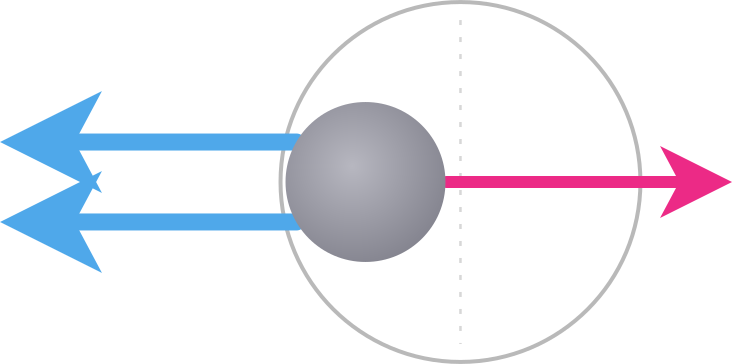
The force a shortened muscle produces divides into two portions. The Resistant Force (RF) is the part absorbed internally to overcome the rigidity of the shortened connective tissue. The Working Force (WF) is the part that remains available to produce useful movement. RF and WF are inversely proportional.
In a muscle with normal connective length, RF is minimal: nearly all the force produced becomes movement. As connective shortening increases, RF rises and WF decreases. The differentiation between Resistant Force and Working Force is the key concept of the entire assessment and treatment approach: establishing how much of a muscle is still available for work, and how much is instead engaged in countering its own rigidity, is what guides where and how to intervene.
The two clinical consequences: statics and dynamics
In statics, the shortened muscle exerts persistent traction at rest. This residual force progressively deforms joint axes, generates compression on the intervertebral discs, and maintains the altered configurations that produce the symptom — before the patient even moves.
In dynamics, increased RF interferes with movement, reduces mechanical efficiency, increases energy expenditure, and forces the system into compensatory motor strategies. The muscle is an intact motor working against a partially engaged brake: the problem is not contractile capacity, but the internal resistance standing between contraction and movement.
Hence an often counterintuitive clinical consequence: strengthening a vectorially imbalanced system can be counterproductive. If the dominant muscles are already shortened, strengthening adds force in the direction already producing the misalignment — the imbalance deepens and compensations consolidate. Strengthening is useful when mechanical conditions allow it, that is, once vectorial balance has been restored. The sequence matters: first rebalance, then strengthen.
The muscular system as a complex system
Muscles do not shorten in isolation. Every muscle shares insertions, force lines, and mechanical relationships with others. When one shortens, the forces acting on its joint change and the system must adapt to maintain equilibrium, redistributing loads to keep the overall centre of gravity within the base of support. The cost is the loss of physiological alignment in other segments, often far from the original shortening.
The symptomatic joint, therefore, is not necessarily the most compromised: it may simply be the point where the system's adaptive capacity has been exceeded. This is why purely local treatment often produces temporary results — the segment improves, but the systemic forces that generated the alteration are still active — and why, conversely, a purely global approach may increase overall mobility without resolving the specific mechanical conflict sustaining the symptom.
The model's two levels: interpretive and applicative
The model operates on two distinct levels, and it is important to keep them separate.
The interpretive level is grounded in biomechanics and the physical laws applied to the musculoskeletal system. It reads joint alterations as the effect of muscular forces, shortenings, compensations, and anatomical dominances. It rests on transferable principles — physical laws, vector analysis, RF-WF mechanics — and is valid as long as those laws are not refuted.
The applicative level translates the interpretive model into therapeutic choices. It is based on individual assessment, patient response, and a sequential strategy not reducible to fixed protocols. It is the level that evolves with knowledge: it currently uses the tools that forty years of clinical practice have confirmed as effective, but if future evidence indicates more effective means, the applicative level adapts while the interpretive level remains.
Vector analysis and predictive capacity
Muscles are not distributed symmetrically around the joints. For each agonist-antagonist system there are intrinsic anatomical asymmetries — in number of muscles, length of force lines, and obliquity of application — that determine vectorial dominances. Vector analysis makes it possible to decompose muscular forces into their components, identify the dominant vectors responsible for a given alteration, and predict the direction in which a joint will deviate, even before observing it clinically.
The distinction between functional equilibrium and pathology is quantitative: small shortenings produce small asymptomatic joint deviations that do not interfere with dynamics — physiological adaptations. Shortenings of greater magnitude produce mechanical conflict and pathology. It is the quantitative assessment of shortenings that guides the therapeutic decision.
Clinical reasoning: primary and secondary shortenings
A musculoskeletal symptom may express a local, referred, or systemic adaptation. Only observation of the system as a whole allows these possibilities to be distinguished. Schematically, the symptom may be:
- the expression of a specific pathology not attributable to local or systemic muscle shortening: here resolution falls outside the method's scope, and the competent medical or physiotherapeutic techniques are used;
- the expression of a muscle shortening with local dominance: the goal is to restore the physiological joint sequence through analytical vectorial rebalancing of the locally acting forces, preventing systemic compensations and worsening;
- the expression of a systemic muscle shortening, primary or secondary: postural analysis is used, checking for alterations arising from subsystems outside the physiotherapy scope, together with analytical and systemic vectorial muscle rebalancing.
The decisive clinical distinction is between primary and secondary shortenings, because it determines therapeutic strategy and prognosis. In primary shortenings, vectorial rebalancing can be resolutive. In secondary shortenings, the muscular system is only the pathway through which a dysfunction originating elsewhere — occlusal, visceral, skeletal, visual or vestibular, neurological — produces misalignment and symptom. Here rebalancing improves the picture, but results are temporary as long as the primary cause remains active: interdisciplinary collaboration with the competent specialist is required.
The clinical signal of secondary shortening is therapeutic instability: corrections do not hold, the symptom returns. This is not treatment failure but diagnostic information — it indicates the primary cause lies outside the muscular system.
The therapeutic tools: isometric contractions at maximum elongation
The increase in Resistant Force depends both on the rise in baseline tone of the contractile portion and on the shortening of the connective portion. The therapeutic tools act on both components.
On the contractile portion, relaxation techniques, proprioceptive techniques, and decontracting massage are used: here there are no true shortenings, but increases in baseline tone, which relaxation is enough to resolve.
On the connective portion, the technique of choice is the isometric contraction performed at maximum physiological or relative elongation of the fibre. For muscle groups to which it cannot be applied, stretching and manual deep-massage techniques along the fibre direction are used.
The mechanism is specific. During an isometric contraction performed at the maximum available length, the contractile portions shorten actively while the connective ones are held in tension: the contraction generates traction on connective tissue already under elongation and, given sufficient force and time, the connective matrix deforms in elongation, up to a deformation that can become permanent. The contractile portions undergo a shortening deformation, but since their elasticity coefficient is higher, the residual shortening is less than the residual elongation of the connective tissue, and is resolved with a relaxation technique at the end of the contraction.
The maximum-elongation condition is critical. If the isometric contraction is performed below the maximum available elongation, mechanical stress concentrates on the connective tissue in compression rather than in elongation, with the risk of increasing RF instead of reducing it. It is the precision of positioning that determines whether the exercise is therapeutic or counterproductive. Current systematic reviews also place precisely these choices at the forefront — active exercise in musculoskeletal pathologies and isometric contractions at greater muscle lengths, associated with superior adaptations in force and tendon structure — as external evidence consistent with the model.
Execution: reasoning applied to real cases
Once analytical and systemic goals are identified, corrective manoeuvres must address the segment involved without introducing aggravating components in any other segment. The asymmetries present represent, for the patient, the best possible equilibrium at that moment: the new equilibrium produced by treatment must be overall better than the one spontaneously adopted. Two examples clarify why the theoretically correct manoeuvre is not enough.
Elevated shoulder. A patient presents an elevated shoulder due to retraction of the homolateral cranio-cervico-scapular muscles. One might use the skull as a fixed point and request active lowering of the shoulder: effective for the upper trapezius, but lowering moves away the scapular insertion of the levator scapulae and the omohyoid. If these are shortened, they will pull on the cervical vertebrae and the hyoid bone. In a patient whose cervical spine is already in lateral convexity on the side of the elevated shoulder, the result would be an improvement of the shoulder but a worsening of the vertebral convexity — therapeutically a serious error.
Dorsal hypokyphosis with T5 apex. Due to retraction of the scapular adductors, one might request active protraction of the shoulders with the pectoralis major as physiological mover, abducting the scapulae and projecting the thoracic spine posteriorly. But if the pectoralis major is replaced by the latissimus dorsi–upper trapezius pair, protraction occurs with shoulder elevation and humeral internal rotation: the posteriorly projected thoracic vertebrae will have their apex between T7 and T12, while T5 loses further kyphosis, with reversal of the dorsal curve and increased cervicodorsal lordosis. Here the muscular substitutions must first be identified and neutralized, creating the conditions so the patient is no longer forced to use them.
Apparently similar dysmorphic pictures may be sustained by completely different vectorial alterations. Therapeutic modalities must therefore be differentiated for each individual, on the basis of the entire static and dynamic examination: this is what makes clinical reasoning complex, but effective.
Efficacy criteria
Efficacy criteria are not limited to immediate symptom relief. At the end of the session three conditions must be present simultaneously: local improvement, overall reduction of tension, and greater system adaptability, without the emergence of new compensatory strategies. When all three are present, the improvement is far more likely to hold; when even one is missing, the result risks being transitory. If a single therapeutic exercise produces no visible changes, subjective and objective, the therapeutic hypothesis is revised.
Clinical fields of application
The main field of interest is orthopaedic pathology:
- vertebral: scoliosis, hyperlordosis, kyphosis, intervertebral disc compression and related radiculopathies, sciatica, cervicobrachialgia;
- articular: osteoarthritis, scapulohumeral conflict, hip osteoarthritis;
- muscular: low back pain, torticollis, myalgias;
- dysmorphic: temporomandibular locking or subluxation, winged scapulae, varus or valgus knees, flat or cavus foot, hallux valgus.
In neurological conditions the method does not replace specific rehabilitation techniques, but can support them, with the aim of limiting the onset of orthopaedic alterations that, adding to the neurological ones, would increase the patient's discomfort.
Relationship with pain neuroscience
The biomechanical model does not replace neurophysiological approaches to pain: it addresses a specific and complementary dimension, namely the mechanical conditions that can initiate, maintain, or amplify nociceptive input over time. Central sensitisation, altered pain processing, and psychosocial factors are recognised contributors to chronic pain; but a persistently compressed disc or a joint held off-axis by shortened dominant vectors are measurable and modifiable mechanical realities. The two planes do not compete: they operate on different levels of the same problem.
Our scientific positioning
The biomechanical model presented here is not “the truth about the human body.” It is the most rigorous hypothesis we have been able to build over more than forty years of clinical and theoretical work, grounded in current knowledge of physics, physiology, and biomechanics, and in the clinical observations that Françoise Mézières transmitted to us. It is a testable hypothesis, open to refutation: as long as clinical observation confirms that muscle shortening alters joint axes and that restoring muscle length resolves symptoms and misalignments, the model holds.
We place ourselves within a historical continuity: Mézières collected the clinical observations of her time and translated them into groundbreaking insights; we translated those insights into verifiable physical and mathematical language; others, after us, will refine and correct. This is why we do not present ourselves as holders of absolute certainties, and we encourage testing what we teach against one's own clinical practice, comparing it with other frameworks, and questioning it when something does not hold up.
Conclusions
In the AIFIMM model, the Mézières Method is an active rehabilitation technique consisting of individual treatments differentiated according to the therapeutic needs and characteristics of each patient. Through the release and re-lengthening of the retracted musculofascial components, it reduces Resistant Force and restores Working Force, recovering the physiological alignment of the joints and bringing the balance between static and dynamic components back toward its ideal condition. What distinguishes the approach is not a repertoire of exercises, but the biomechanical reasoning that, starting from vector analysis of forces, establishes what to treat, in what sequence, and according to which force relationships.
Physical foundations of the model.
This article applies the AIFIMM biomechanical model.
Its physical foundations are developed in three sequential articles, best read in order:
1. How muscle shortening generates joint conflict — why muscles shorten and the Resistant Force / Working Force model
2. Do antigravity muscles really oppose gravity? — how segmental malalignment raises Resistant Force
3. Why joint conflict develops: vector analysis of muscular forces — how the responsible forces are identified and predicted
This topic is part of the online course Systemic and Segmental MSK Biomechanics.