


The hyoid bone in cranio-cervical biomechanics: a point of mechanical convergence and force redistribution
Mauro Lastrico, Laura Manni – Physiotherapists
The hyoid bone is entirely suspended in the anterior region of the neck, with no articulations to other skeletal segments. Its position in space is determined exclusively by the balance of muscular forces converging on it. This characteristic makes it a mechanical node of the cranio-cervico-scapular system: a point of convergence and redistribution of tensions between cranium, mandible, sternum, and scapula.
The attached PDF document, available for free download, develops the complete vector analysis with images and bibliographic references.
Six muscular systems, one point of convergence
Muscles from the cranium, mandible, sternum, scapula, larynx, and pharynx converge on the hyoid bone. Through these connections, the hyoid participates as a passive element in complex functions: mandibular opening, swallowing, phonation, respiration, and adapts to changes in cranio-cervical axes and scapular position.
The hyoid bone exerts no autonomous regulatory action. Every positional variation is the passive resultant of the balance of converging muscular forces.
Mechanical relay
When tension changes in any of the inserted muscles, the force balance is altered and the bone is passively displaced into a new position. This displacement induces the other muscles of the system to increase tone in order to adapt to the new geometry. Since these muscles are connected to other skeletal regions, tension alterations propagate to the cranium, mandible, cervical vertebrae, and scapula.
As in an electrical relay, where variation in one circuit influences the connected circuits, tension modifications reaching the hyoid bone through one muscular group determine mechanical variations in all other inserted muscles. A tension arising from the scapular region may mechanically influence the mandibular region, and vice versa.
Vector dominance of the suprahyoid muscles
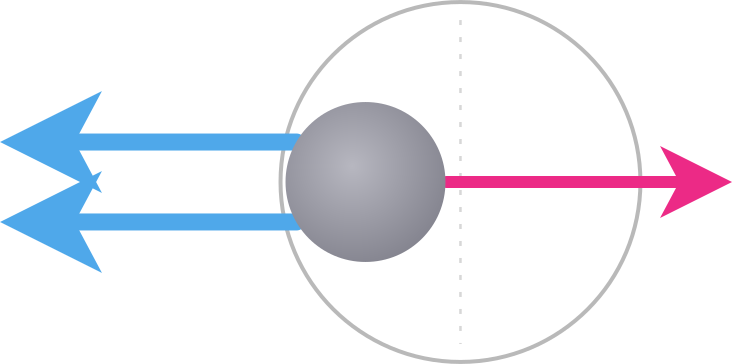
Vector analysis shows clear dominance of the suprahyoid muscles over the infrahyoid muscles. The digastrics, stylohyoids, geniohyoids, and mylohyoids are more numerous and present stronger force vectors, with more favourable angulations for traction in the cranial and anterior direction.
The infrahyoid muscles — sternohyoid, omohyoid, thyrohyoid — are subdominant. Their ability to oppose upward traction is limited both by their smaller number and by their less favourable vector arrangement.
When excessive tensions develop, suprahyoid dominance produces elevation and anterior displacement of the bone, with the anterior belly of the digastric playing the prevailing role. If omohyoid tension is asymmetrical, lateral deviation may also be added. True lowering of the hyoid bone is not observed in clinical practice.
Functional consequences of elevation
With the hyoid bone stably elevated due to suprahyoid dominance, alterations are produced in four areas.
Swallowing: occlusal problems or cranio-cervical musculoskeletal imbalances may interfere with the proper balance between hyoid muscles and mandibular closing muscles, leading to atypical swallowing patterns.
Phonation: the hyoid bone is connected to the larynx through the thyrohyoid membrane and the thyrohyoid muscle. With the hyoid elevated, caudal excursion of the larynx is limited. The voice tends toward higher frequencies — not in volume but in timbre — with reduced modulation capacity and potential vocal fatigue.
Respiration: during physiological inspiration, the hyoid bone should accompany diaphragmatic descent through the action of the infrahyoid muscles. With the hyoid elevated, the inspiratory caudal movement is limited or absent. The bone remains fixed in an elevated position instead of following the respiratory rhythm.
Cranio-cervical axes: the altered bone position mechanically modifies the tensions of all muscles in the region, contributing to changes in cranial position, alterations of cervical curves, and cranio-cervical tension asymmetries.
Clinical assessment
On direct palpation, the hyoid bone should theoretically lie midway between the inferior mandibular border and the thyroid prominence. In clinical practice, it is often found elevated. The distance from the inferior mandibular border and symmetry relative to the midline are assessed. During swallowing, vertical and anterior excursion is observed. During phonation, positional changes with vocal frequency variation are assessed.
Anterior displacement of the hyoid bone also produces anterior traction on the middle cervical vertebrae, contributing to anterior projection of the cervical spine.
Physical foundations of the model.
This article applies the AIFIMM biomechanical model.
Its physical foundations are developed in three sequential articles, best read in order:
1. How muscle shortening generates joint conflict — why muscles shorten and the Resistant Force / Working Force model
2. Do antigravity muscles really oppose gravity? — how segmental malalignment raises Resistant Force
3. Why joint conflict develops: vector analysis of muscular forces — how the responsible forces are identified and predicted
This topic is part of the online course MSK Clinical Vectorial Model.