


Beyond muscle chains: the musculoskeletal system as a complex system
Mauro Lastrico, Laura Manni – Physiotherapists
The concept of "muscle chains" describes a real phenomenon — muscles operate in interconnected systems — but explains it with a linear model that does not account for what is observed clinically: why small dysfunctions generate widespread symptoms, why compensations are often unpredictable, and why the body develops adaptive strategies that cannot be deduced from analysis of individual elements. Complex systems theory provides the physical-mathematical framework that transforms these empirical observations into quantifiable analyses.
The attached PDF document, available for free download, develops the complete model with images and bibliographic references.
From empiricism to science
The concept of the kinematic chain dates back to Reuleaux (1875). From the 1940s onward, several researchers in physiotherapy — Mézières in France, then Souchard, Busquet, Myers — observed that groups of polyarticular muscles behave as integrated functional systems. These clinical intuitions, initially lacking rigorous mathematical models, highlighted real phenomena that complex systems physics can now explain formally.
Four characteristics of complex systems
First: interdependence and interaction
In a complex system, all elements are interdependent. Every segmental action localised to one body region determines adaptations in adjacent regions. These adaptations may be corrective or aggravating.
The clinical example: a patient with femoral internal rotation is asked to actively correct it. The local correction produces anterior trunk flexion, lateral displacement, upper limb abduction, widening of the base of support — a systemic aggravation greater than the correction obtained. Even a theoretically low-energy request, such as humeral derotation, may activate co-contractions of the scapular adductors, latissimus dorsi, and subscapularis, producing thoracic vertebral compression.
Self-corrections — a parent telling a child to "stand up straight", corrections in front of a mirror — may conceal the risk of structural aggravation.
Second: understanding is only systemic
Function can be understood only by considering the system as a whole. The symptom may be the expression of a local disorder, a referred disorder, or systemic distress. Identifying the central origin of peripheral symptoms requires a global musculoskeletal analysis.
Third: emergent abilities and substitutive moments
The system generates solutions that cannot be predicted from examination of individual elements. When muscles anatomically assigned to an action are subdominant due to excess Resistant Force of the antagonists, the system integrates or replaces them with muscles that, according to linear vector analysis, should not be involved. The "what" takes priority over the "how".
The muscles that tend to be substituted are predictable according to the mathematical logic of force couples: infrahyoids, serratus anterior, rectus abdominis, triceps brachii, quadriceps femoris, and monoarticular muscles in general. These are the same muscles that in the historical muscle chain literature were empirically identified as "non-integrated elements" — they now find a mathematical explanation in force couple theory.
The therapeutic goal is not to strengthen subdominant muscles but to free them from interference by dominant muscles through recovery of length in the muscles with excess Resistant Force.
Fourth: equilibrium at the edge of chaos
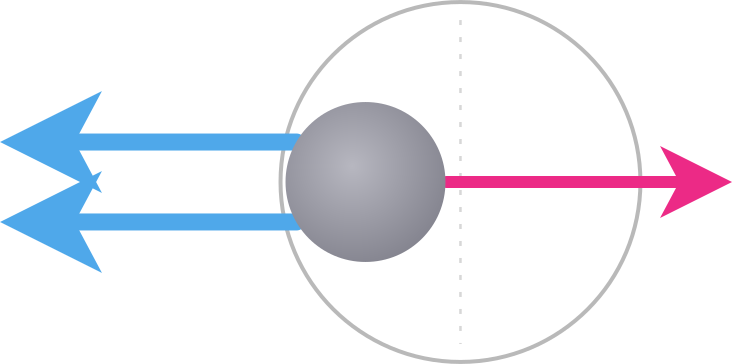
The system operates with maximum efficiency when Work Force dominates over Resistant Force. In this condition, small signals can modify the system's state with minimal energy expenditure. If Resistant Force increases, the system becomes rigid and moves away from the edge of chaos. A self-reinforcing circuit is triggered: misaligned centres of mass → increased basal tone → connective shortening → further misalignment.
Physical foundations of the model.
This article applies the AIFIMM biomechanical model.
Its physical foundations are developed in three sequential articles, best read in order:
1. How muscle shortening generates joint conflict — why muscles shorten and the Resistant Force / Working Force model
2. Do antigravity muscles really oppose gravity? — how segmental malalignment raises Resistant Force
3. Why joint conflict develops: vector analysis of muscular forces — how the responsible forces are identified and predicted
This topic is part of the online course MSK Clinical Vectorial Model.