


Free e-book: physical and clinical foundations of the AIFIMM biomechanical model
Mauro Lastrico, Laura Manni – Physiotherapists
This e-book presents the theoretical and clinical principles underlying the analytical and systemic biomechanical model developed by AIFIMM — Institute of Applied Musculoskeletal Biomechanics.
It does not describe techniques or protocols. It provides the conceptual framework that explains why muscles shorten, how shortening alters joint mechanics, and why symptoms recur despite treatment.
What the e-book covers
The physical principle of muscle shortening. Muscle contains two materials with different elastic properties. The connective component retains residual deformations proportional to the force × time product. This is not pathology — it is physics applied to biological tissues.
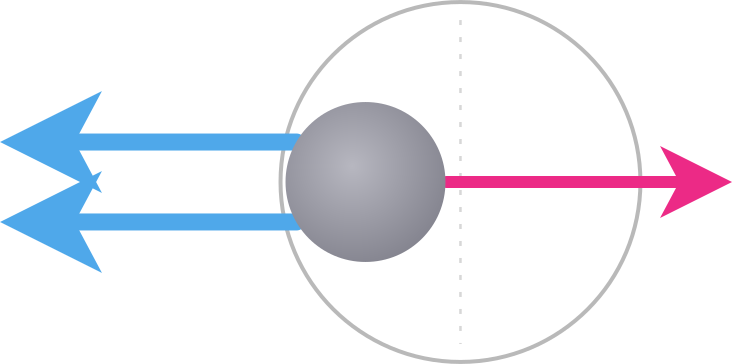
The Resistant Force / Work Force model. Shortening increases Resistant Force and reduces Work Force. A shortened muscle resists but does not work. This explains why strengthening alone does not correct joint alignment when dominant vectors maintain excess Resistant Force.
The predictive power of vector analysis. Muscles are not distributed symmetrically around joints. Anatomical vector dominances determine which alterations emerge first and in which directions. Clinical reasoning shifts from "I observe and seek an explanation" to "I know the dominances, I predict the alterations, I verify."
The musculoskeletal system as a complex system. Every local intervention modifies global equilibrium. Emergent abilities, substitutive strategies, and the principle of equilibrium at the edge of chaos explain why local corrections can produce systemic aggravation.
Pain, adaptation, and clinical reasoning. Three systems produce muscle shortening: psychosomatic, neurophysiological, and biomechanical. The a priori antalgic reflex — permanent contraction preventing latent conflicts from manifesting — explains the progressive accumulation of shortening in every human body.
From physical principles to therapeutic strategies. Reducing Resistant Force is the prerequisite for restoring Work Force. Treatment must be simultaneously analytical and systemic: resolving the local conflict without lowering the systemic ceiling.
Clinical application. The model applies to chronic, recurrent, and treatment-resistant musculoskeletal presentations — not because these are more difficult cases, but because in these conditions the symptom persists precisely because the forces responsible for joint misalignment have not been identified.
Epistemological positioning. The model is not "the truth about the human body." It is the most solid hypothesis constructed over 40 years of clinical and theoretical work. Scientific rigour is not defending a model at all costs — it is building verifiable hypotheses and accepting they will be superseded.
About the authors
Mauro Lastrico and Laura Manni are physiotherapists with over 40 years of clinical experience. They trained directly with Françoise Mézières in Paris between 1988 and 1990, during the final years of her teaching. From this direct continuity, they developed the AIFIMM biomechanical model: preserving the core of the method and making it verifiable through the language of musculoskeletal biomechanics and complex systems physics.
AIFIMM has trained over 6,000 physiotherapists in 25 years of activity.
From the e-book to clinical application
The principles presented in the e-book are the foundation of the online course:
MSK Clinical Vectorial Model 38 CPD hours (CPD Certification Service UK) — 45 contact hours / 4.5 CEU (Florida, USA) 18 videos, 38 hours, downloadable PDF materials, theoretical exposition and practical demonstrations. Professionally dubbed into English by professional actors.