
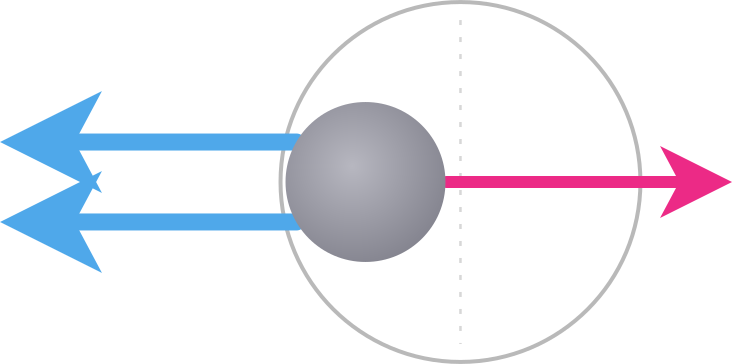


Systemic musculoskeletal biomechanics: a clinical model based on vector analysis
Mauro Lastrico, Laura Manni – Physiotherapists
Systemic musculoskeletal biomechanics is a clinical model that interprets joint and spinal dysfunctions as the result of progressive shortening of myofascial units. Through vector analysis of muscular forces, it identifies the mechanical causes of pain, stiffness, and recurrence, and guides treatment based on verifiable physical laws.
The clinical problem
Chronic and recurrent musculoskeletal dysfunctions represent a significant share of the clinical load in physiotherapy. In many cases, symptoms return after treatment or migrate to a different area. This behaviour suggests that the cause lies outside the symptomatic segment. A model that analyses a single segment in isolation may resolve the local symptom but has no tools to intercept the mechanism that generates and reproduces it.
Foundations of the model
Muscle, understood as a myofascial unit, is an elastic body with a single active property: contractile capacity. Over time, its connective tissue components tend to shorten. Shortening percentages as small as 1–3% are sufficient to alter joint geometry.
Shortening of a muscular vector generates constant traction on the bony attachments. At joint level, this produces malalignment and compression. In the spine, if symmetrically arranged muscles are shortened asymmetrically, the result is compression combined with vertebral body rotation, with potential radicular impingement.
This mechanism is formalised in the relationship between Resistant Force and Work Force. Shortening increases Resistant Force — the passive resistance the muscle opposes to movement — and reduces Work Force — functional contractile capacity. The two quantities are inversely proportional. A shortened muscle resists but has lost the ability to contract effectively: it resists, but does not work.
The body as a complex system
The muscular system functions as a network: every local variation modifies global equilibrium. This property has direct clinical consequences.
When a muscular vector is inefficient, the system recruits muscles other than those expected by the physiological pattern to achieve the same motor objective. The body organises movement by result, and uses whatever resources are available to obtain it. These substitutive strategies — defined as emergent abilities — alter joint dynamics and generate abnormal loads on structures not designed to sustain them.
Muscular forces tend to organise into synergistic couples, which prevail through mechanical and economic advantage over isolated forces. Certain muscles — infrahyoids, serratus anterior, triceps brachii, rectus abdominis, rectus femoris, and mono-articular muscles in general — tend to be functionally inhibited. The cause is not intrinsic weakness but the entropic advantage of the muscle groups that overpower them.
Biomechanical diagnosis: three levels
The model provides three levels of diagnostic analysis.
The first level is vector analysis: identifying which muscular shortenings are responsible for intra-articular mechanical conflicts and compressive phenomena on joints and intervertebral discs.
The second level is the identification of emergent abilities: recognising which substitutive strategies the system has developed that mask the actual motor deficit.
The third level is differential diagnosis between primary shortenings — of myofascial origin — and secondary shortenings, determined by stomatognathic, visceral, neurological, or skeletal causes, which require collaboration with the relevant professionals.
Therapeutic tools
Treatment is based on three tools: isometric contractions performed at maximum physiological lengthening, physiological diaphragmatic breathing, and proprioceptive recalibration. The objective is to reduce Resistant Force and restore the functionality of inhibited myofascial units, returning to the system the capacity to self-organise efficiently.
This clinical toolset derives from the original work of Françoise Mézières, a French physiotherapist who in 1947 first identified the role of muscular shortening as the primary cause of morphological dysfunction. The biomechanical model described here represents the formalisation and evolution of that clinical intuition in the light of the laws of physics and complex systems theory.
This topic is part of the online course MSK Clinical Vectorial Model.
References
[1] Fung YC. Biomechanics: Mechanical Properties of Living Tissues. 2nd ed. New York: Springer-Verlag; 1993. [2] Purslow PP. The structure and role of intramuscular connective tissue in muscle function. Front Physiol. 2020;11:495. [3] Lieber RL. Skeletal Muscle Structure, Function, and Plasticity. 3rd ed. Philadelphia: Lippincott Williams & Wilkins; 2010. [4] Gajdosik RL. Passive extensibility of skeletal muscle: review of the literature with clinical implications. Clin Biomech. 2001;16(2):87-101. [5] Adams MA, Dolan P. Spine biomechanics. J Biomech. 2005;38(10):1972-1983. [6] Felson DT. Osteoarthritis as a disease of mechanics. Osteoarthritis Cartilage. 2013;21(1):10-15. [7] Andriacchi TP, Mündermann A. The role of ambulatory mechanics in the initiation and progression of knee osteoarthritis. Curr Opin Rheumatol. 2006;18(5):514-518. [8] Janda V. Muscles and motor control in cervicogenic disorders. In: Grant R, editor. Physical Therapy of the Cervical and Thoracic Spine. New York: Churchill Livingstone; 1994. p. 195-216. [9] Sahrmann SA. Diagnosis and Treatment of Movement Impairment Syndromes. St. Louis: Mosby; 2002. [10] Page P, Frank CC, Lardner R. Assessment and Treatment of Muscle Imbalance: The Janda Approach. Champaign: Human Kinetics; 2010. [11] Winter DA. Biomechanics and Motor Control of Human Movement. 4th ed. Hoboken: John Wiley & Sons; 2009. [12] Neumann DA. Kinesiology of the Musculoskeletal System. 3rd ed. St. Louis: Elsevier; 2017.